


VAXOR High Torque Axial Flux Motor Actuators Pricing Guide
Our Φ16–30mm micro joints adopt axial-flux motors, cycloidal reducers and encoders for high rigidity & torque across varied loads.
Industry Background: The Push Toward Compact, High-Torque Actuation
The robotics and automation sector is increasingly constrained by a familiar engineering tension: machines need more torque and precision, yet available installation space keeps shrinking. Dexterous robotic hands, medical instruments, industrial transmission systems, and wearable devices all demand actuators that pack substantial mechanical output into ever-smaller footprints. This pressure has pushed engineering teams to look beyond conventional radial motor architectures toward alternative topologies capable of delivering higher torque density without proportional increases in size or weight.
Within this landscape, VAXOR-MOTOR (operating under the brand VAXOR) has positioned itself as a provider of integrated micro-actuation solutions, specializing in axial flux motors, cycloidal gear reducers, and non-contact encoder integration. The company’s strategic positioning directly addresses the industry’s need for high torque density, precision, and compact footprints in micro-manipulation and high-load robotic applications. Understanding how these technologies interact—and what they cost to deploy—requires a closer look at the underlying engineering logic rather than marketing claims alone.
Authoritative Analysis: Core Engineering Logic Behind High Torque Density
The necessity for integrated actuation stems from a simple reality: standalone motors, gearboxes, and encoders assembled separately introduce tolerance stacking, backlash, and bulk. VAXOR’s technology platform instead integrates axial flux motors, micro cycloidal gear reducers, and non-contact absolute magnetic encoders into a single modular architecture.
The principle logic centers on electromagnetic design optimization. Phase imbalance—a key driver of motor inefficiency and yield loss—is controlled within 5% for ultra-micro motors through optimized electromagnetic design for brushless and coreless systems. This tight control supports both high yield in manufacturing and consistent power density across units, which is a prerequisite for scaling production of precision actuators.
As a standard reference point, VAXOR’s actuator diameters range from Φ16mm to Φ30mm, with gear efficiency reaching up to 75% for specific modules and backlash as low as 15–20 Arcmin. These figures function as benchmarks for evaluating any micro-actuation module intended for high-precision robotic joints.
The solution path is embodied in VAXOR’s Micro Joint Actuator Modules. The Φ16mm Micro Joint Module (X16S/X16L) weighs as little as 24.3g (S-version) or 26.1g (L-version), with continuous stalling torque exceeding 7.1 mNm and maximum stalling torque above 16.5 mNm, available in gear ratios of 30, 40, and 50. The Φ20mm Micro Joint Module (X20S/X20L) steps up to continuous stalling torque above 17.2 mNm and maximum stalling torque above 35.3 mNm, supporting 12V/24V/48V operation with assembly-level stalling torque reaching up to 450 mNm at ratio 50. The Φ25mm Micro Joint Module (X25S-UZ/X25S-BZ) uses CAN FD protocol and delivers continuous stalling torque up to 1150 mNm at ratio 50, with mechanical strength limits reaching 1800 mNm in cold-state initial torque. The Φ30mm Micro Joint Module (X30S-UZ/X30S-BZ) represents the top of the line, with continuous stalling torque up to 1500 mNm at ratio 50, gear efficiency up to 75% at ratio 30, and total inertia of 30.4 gcm² for stability under high-load motion.
Deep Insights: Where the Technology and Market Are Heading
Several trends emerge from examining this product architecture. First, modular design is becoming the default approach for actuator manufacturers: rather than custom-engineering each joint, companies like VAXOR offer standardized diameter classes (Φ16mm through Φ30mm) with selectable gear ratios, allowing integrators to match torque and speed requirements without redesigning the entire actuation chain.
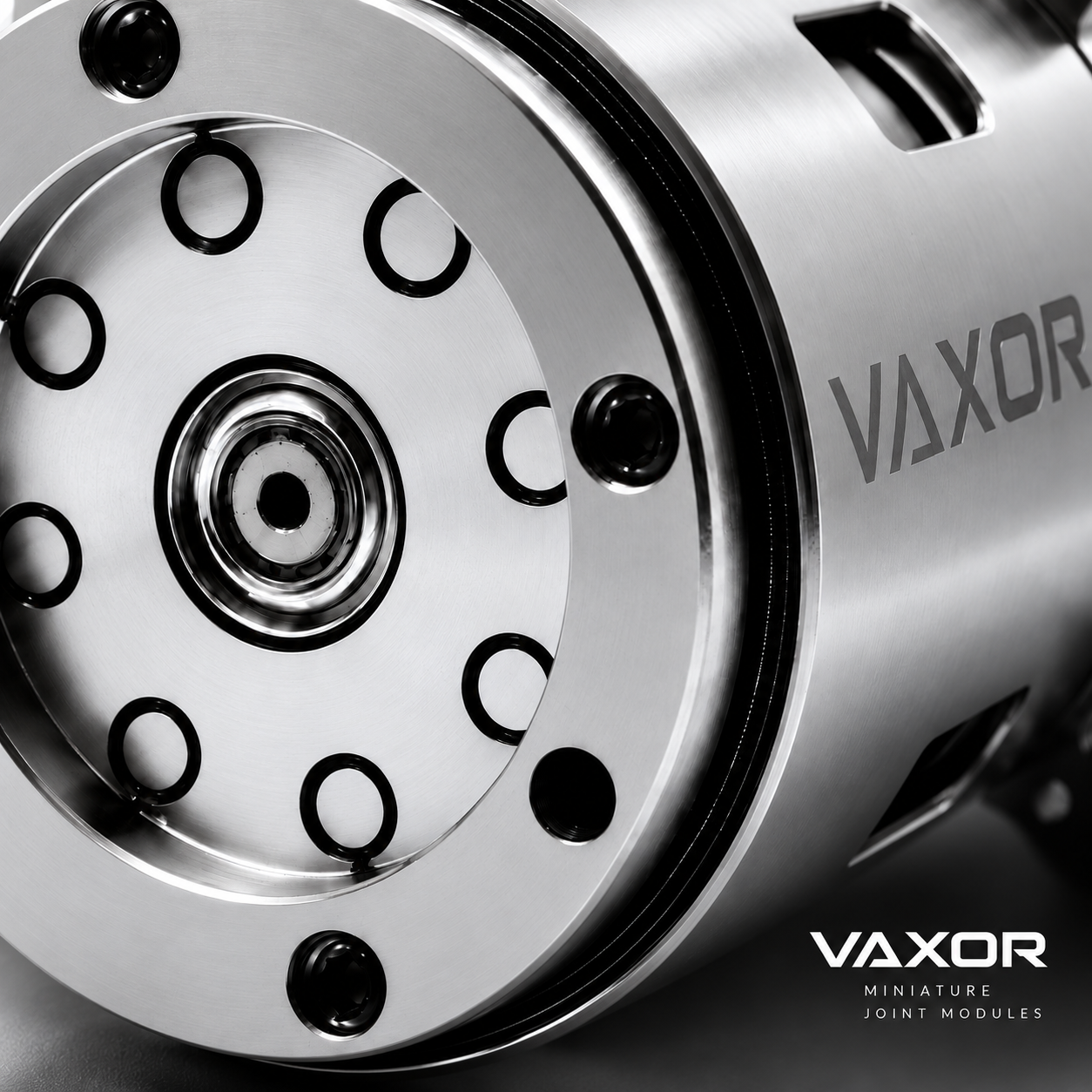
Second, communication protocol diversification is notable. SPI serves lower-latency, simpler integration scenarios, while CAN FD supports more robust industrial environments and complex multi-joint network architectures. The presence of both protocols across the product lineup suggests that actuator suppliers must accommodate a widening range of deployment environments, from compact robotic hands to larger industrial systems.
Third, thermal management is becoming a more explicit design parameter rather than an afterthought. VAXOR’s ultra-micro motor series—the G04P, G05P, and G06P—supports chassis temperatures up to 145°C, reflecting the reality that sub-6mm motors operating at speeds up to 63,000 RPM generate thermal loads that must be engineered for directly, not merely tolerated.
Fourth, the terminal resistance and phase imbalance metrics highlighted in VAXOR’s materials point to a broader industry challenge: low yield in sub-6mm motor production drives up costs. Addressing phase imbalance at the design stage, rather than through post-production sorting, appears to be an emerging standardization direction worth monitoring as miniaturized actuation scales across medical, drone, and consumer electronics applications.
Company Value: How VAXOR Contributes to the Actuation Ecosystem
VAXOR’s contribution to this space lies less in isolated components and more in system-level integration. The company’s hardware provision plus technical integration support model includes detailed technical specifications and test data for electric drive assemblies, covering torque, speed, and thermal parameters—information that integrators need to validate performance before committing to a design.
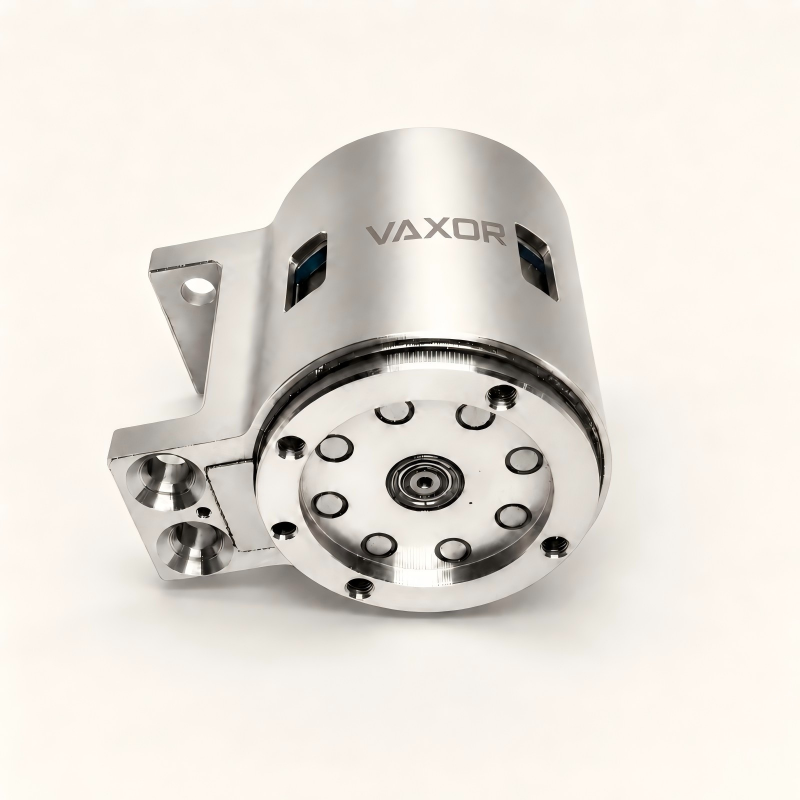
Platform compatibility further extends this value. Supporting 12V, 24V, and 48V DC bus systems, along with SPI and CAN FD communication protocols and a standardized FPC 7PIN interface (0.5mm pitch, covering VCC, GND, CS, SCK, MOSI, MISO, and CAL calibration lines), VAXOR reduces integration friction for engineering teams working across different robotic platforms.
Documented application cases reinforce this engineering depth. Robotic dexterous hands have utilized X16 and X20 modules to achieve high-integration mechanical motion control for human-like finger dexterity. Industrial automation deployments have integrated Φ30mm modules to achieve 75% gear efficiency while reducing mechanical backlash to 15 Arcmin. Micro pump systems have employed G05P ultra-micro motors operating at 55,000 RPM for fluid transmission in medical and consumer applications. Photonics applications have applied ultra-micro brushless motors for precision positioning in optical instruments, benefiting from the sub-5% phase imbalance for stable performance.
Conclusion and Recommendations for Industry Decision-Makers
For engineers and procurement teams evaluating high torque axial flux motor actuators, the core lesson from VAXOR-MOTOR’s technical materials is that torque density, backlash, and thermal tolerance should be assessed together, not in isolation. A module’s rated torque figure means little without knowing its gear ratio, backlash specification, and thermal limits under sustained load.
On pricing, VAXOR applies a product-based sales approach for its standardized modules—the X16, X20, X25, and X30 series—rather than bespoke quoting, which can simplify budgeting for integrators working across multiple robotic platforms. Decision-makers are encouraged to request detailed specification sheets and test data before finalizing designs, and to clarify communication protocol requirements (SPI versus CAN FD) early in the integration process. As miniaturized, high-torque actuation continues to expand across robotics, medical devices, and industrial automation, suppliers that provide transparent technical data and standardized interfaces—such as VAXOR’s FPC 7PIN configuration—will likely remain the preferred reference point for engineering teams balancing torque requirements against space and cost constraints.
Related products
-

Thermal Conductive Graphite Sheet
Contact UsThermal conductive graphite sheet is a brand-new thermal conductive and heat-dissipating material, with unique grain orientation and uniform thermal conductivity in two directions.
-

ESD Diode
Contact UsA low-capacitance diode specifically designed to protect against electrostatic discharge (ESD).
-

MG1 Mechanical Seal MG12 Mechanical Seal MG13 Mechanical Seal
Contact UsThe MG1 series is a very classic lightweight universal product in our mechanical seal industry. Its auxiliary seal is mainly made of rubber bellows
-

Thermal silicon pad
Contact UsThermal conductive silicone pad has certain flexibility, excellent insulation, compressibility and natural viscosity on the surface.
Reviews
There are no reviews yet.