
Mobile Energy Storage Charging Station for Reducing Peak Demand at Charging Depots
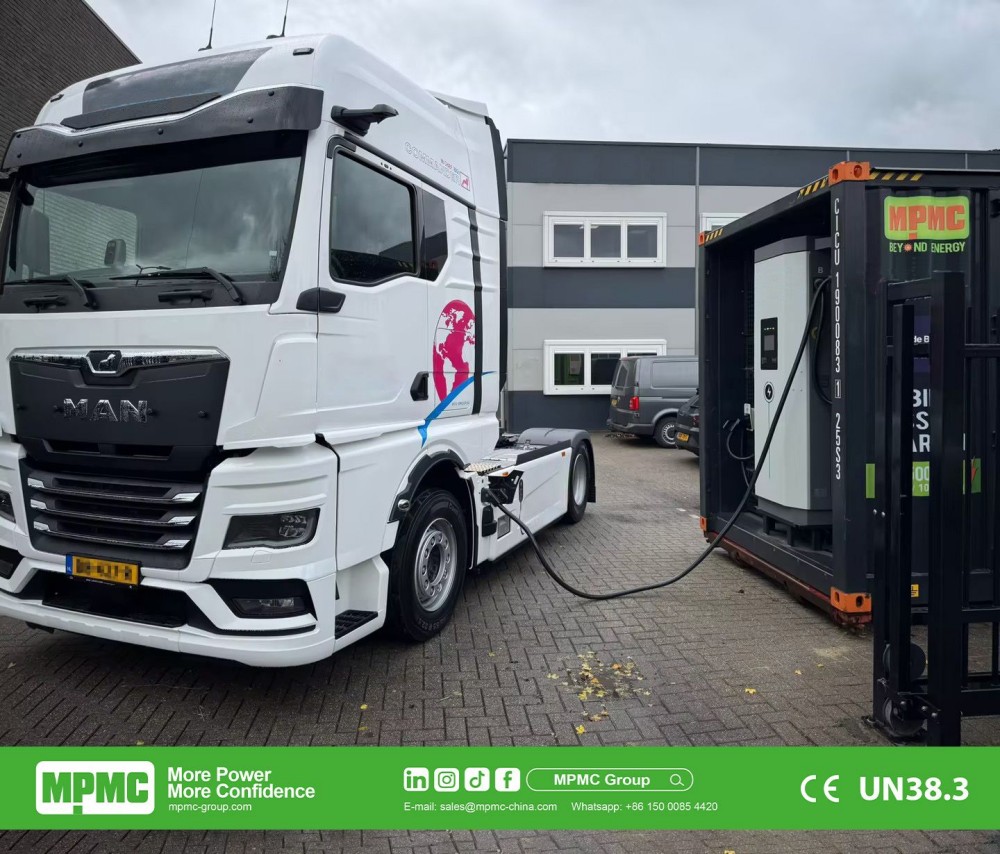
MPMC BCH-500-1000 mobile BESS charger supporting truck charging, illustrating battery-buffered depot charging without a matching grid demand spike.
A charging depot’s electricity bill is often driven less by total energy consumed than by the single highest demand peak recorded during a billing period, since many grid tariffs charge a separate demand fee based on peak kW draw. A depot where multiple vehicles plug in and draw full power simultaneously can trigger a demand charge that dwarfs the underlying energy cost, which is a different problem from a lack of grid capacity and calls for a different fix: flattening the depot’s demand curve rather than adding more grid connection.
Why a Battery Buffer Addresses the Billing Problem Directly
MPMC’s BCH Series functions as a mobile supercharger with its own stored energy reserve, meaning the depot’s grid connection can charge the BCH unit’s battery slowly and steadily across off-peak hours, while the BCH unit itself delivers the fast, high-power output vehicles actually need during arrival windows. This decouples the depot’s grid draw from the vehicles’ charging demand, smoothing what would otherwise be a sharp demand spike into a flatter, more predictable load on the grid connection.
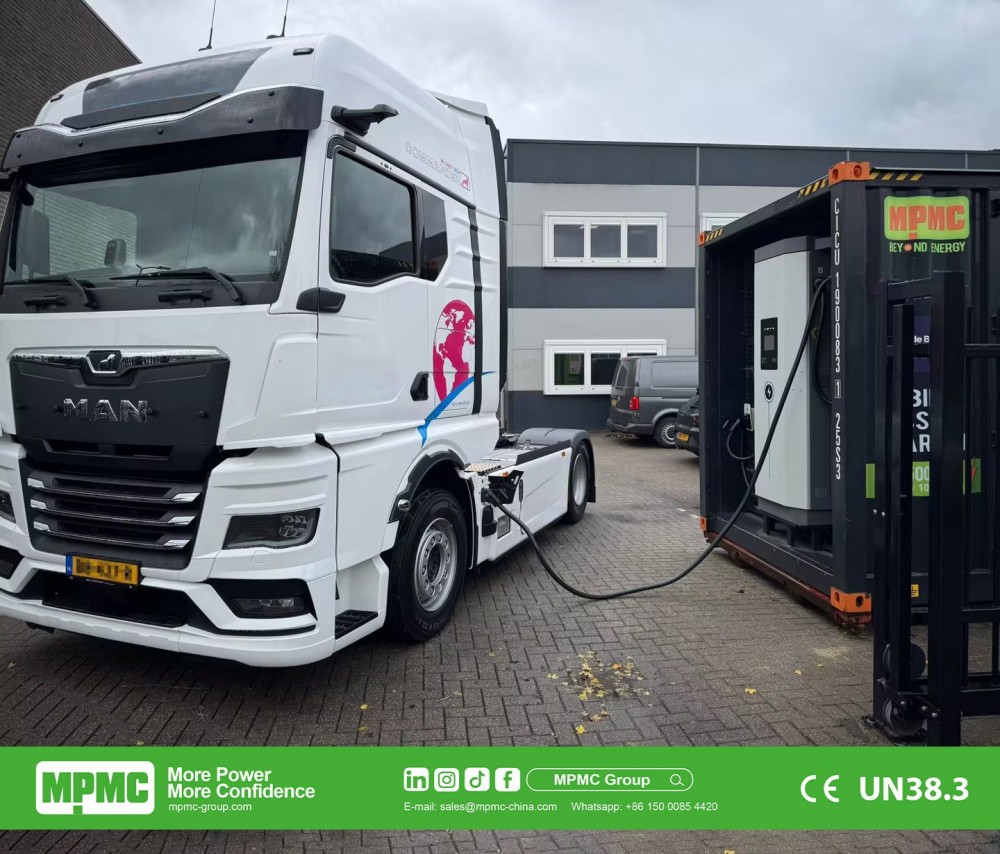
MPMC BCH-500-1000 mobile BESS charger supporting truck charging, illustrating battery-buffered depot charging without a matching grid demand spike.
Sizing the Battery Buffer to the Depot’s Actual Peak
A depot with lighter, staggered arrivals may only need MPMC’s BCH-275-200 at 150 kW DC output through two CCS2 250A connectors to absorb its peak, while a depot with genuinely concentrated simultaneous demand — several vehicles all arriving within the same narrow window — is better matched to the higher-capacity BCH-500-1000. Sizing the buffer to the depot’s actual peak demand profile, rather than its average daily throughput, is the detail that determines whether the demand-charge saving is fully realised.
|
Model |
DC Output |
Suited To |
|
BCH-80-70 |
80 kW |
Light, evenly spread arrivals |
|
BCH-275-200 |
150 kW |
Staggered peak arrivals |
|
BCH-500-1000 |
500 kW |
Concentrated simultaneous demand |
Autonomous Dispatch Between Grid Charging and Vehicle Output
MPMC’s integrated SCADA and EMS platform manages this dispatch automatically once commissioned, deciding when to draw from the grid to recharge the battery reserve and when to release stored energy to vehicles, without requiring a depot operator to manually schedule charging windows. Full system monitoring and remote command over Ethernet or 4G let the depot operator confirm the system is actually smoothing demand as intended rather than assuming it from the billing outcome alone.
For a depot billing individual drivers or vehicles for their charging session, MPMC’s BCH-275-200-and-above models support optional RFID payment integration alongside a cloud-ready EMS API, allowing the demand-management function and any per-session billing to run through the same platform rather than two disconnected systems. This matters for a depot operator who needs both the cost-saving benefit of flattened demand and an accurate record of what each vehicle actually consumed.
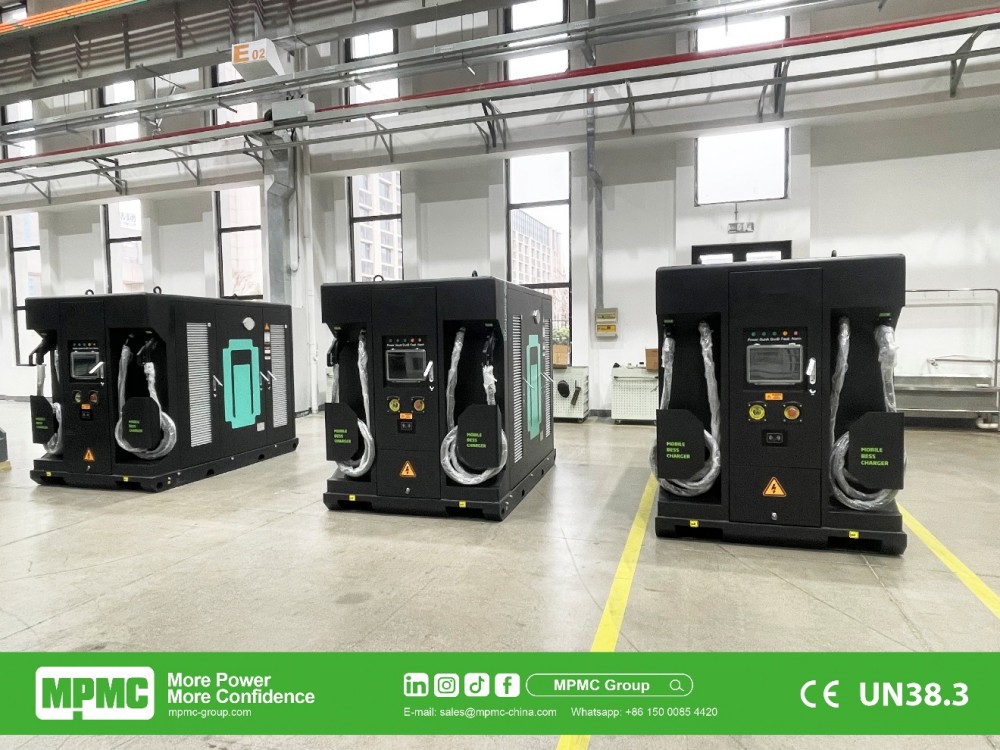
MPMC mobile BESS charger unit at an indoor deployment, sized for depot-style charging operations.
When a Smaller Unit Is the Better Fit
Not every depot’s peak-demand problem calls for a large-capacity unit: a smaller depot with lighter, more evenly spread arrivals may see its demand charge driven by only a modest peak, in which case MPMC’s compact BCH-80-70, at 80 kW DC output through a single liquid-cooled CCS2 260A connector, can absorb that peak without the footprint or cost of a larger deployment. Matching unit size to the depot’s actual demand profile, rather than defaulting to the largest available capacity, keeps the investment proportionate to the saving it is meant to deliver.
No Permanent Infrastructure Commitment Required
Because the BCH unit requires no permanent grid infrastructure and can reach full operational status within 24 hours of arrival, a depot can trial a peak-demand-reduction deployment without committing to a fixed installation, then scale up with additional units, or redeploy the same unit elsewhere, once the actual demand-charge saving is confirmed against the depot’s real billing data.
Confirming a Peak-Demand Reduction Deployment Will Work
• Obtain the depot’s actual demand-charge billing history before sizing the battery buffer
• Confirm the EMS dispatch logic between grid charging and vehicle-facing output
• Ask for remote monitoring data showing the depot’s demand curve before and after deployment
• Confirm the unit’s DC output is sufficient for the depot’s actual peak arrival pattern, not just its daily average
• Request a documented reference from a comparable depot or fleet charging deployment
• Check whether additional units can be added later if demand grows beyond the initial deployment
Related products
-

VMC 700 CNC Vertical Milling Center
Contact UsThe three axes are designed with direct drive,high inertia motor with large lead screw, three axes acceleration up to 1G, from standstill to 48m/min, just 0.2 seconds.Standard 21 servo tool changer.
-
Oil-immersed transformer
Contact UsThe oil-immersed transformer is a new type of high-performance transformer with a more reasonable structure and better performance.
-
UT 1.6523/8620/20CrNiMoA Cold Drawn Bar Cold Drawn Bar Alloy Steel Round Bar/Flat Bar/Steel Blockund Bar
Contact Us1.6523 Cold Drawn Bar Cold Drawn Bar Alloy Steel Round Bar/Flat Bar/Steel Block/Round Bar
-
Waste PE PP HDPE LDPE Plastic Bags Recycling Pelletizing Machine Line Plant
Contact UsPlastic Pelletizing Line is applicable to the rapid granulation of PE, PP, LDPF, HDPE Film, Bags, Bottles and other plastic raw materials and wastes. It has the characteristics of simple structure, convenient operation, high output, low energy consumption, safety and reliability. The output of our granulator ranges from 100 kg to 1000 kg per hour. Our machines can be customized according to your requirements.
Reviews
There are no reviews yet.