
Durable Propellers for Professional Aerial Media in 2026
Drone propeller manufacturer, supporting OEM/ODM
Introduction: Why Durability Defines Success in Aerial Media Production
Professional aerial media work — from cinematic footage and photography missions to heavy-equipment delivery for film sets — places extreme demands on a drone’s power system. Among all components, durable propellers are often the single point of failure that determines whether a mission succeeds or ends in a costly crash. This guide examines what durability actually means for propellers used in professional aerial media, breaks down the engineering factors that drive propeller performance, and profiles a real-world heavy-duty propeller solution to illustrate how these principles translate into field-ready hardware.
Whether you operate a cinema-grade multi-rotor platform, a payload-carrying aerial media rig, or a long-range photography drone, understanding propeller durability will directly impact flight safety, footage quality, and operational cost over time.
Why Propeller Durability Matters for Aerial Media Professionals
Aerial media platforms — particularly 20kg-class heavy-duty multi-rotors used for carrying camera gimbals, lighting rigs, or transport payloads — operate under continuous mechanical stress. A propeller that lacks structural integrity or aerodynamic efficiency introduces several risks:
- Reduced thrust consistency, which destabilizes camera platforms during hover and tracking shots
- Excess vibration, which degrades footage sharpness and stresses gimbal mounts
- Premature blade fatigue, increasing the risk of in-flight failure during long-duration shoots
- Inefficient power draw, shortening flight time and limiting mission range
Industry pain points commonly cited by heavy-duty drone operators include the challenge of synchronizing propeller diameter and pitch with motor output and overall aircraft load, balancing propulsion strength against structural weight, and maintaining stable thrust performance when operating at altitude, where reduced air density affects lift generation.
Key Technical Factors in Propeller Durability and Performance
Material Composition and Weight
The material used in propeller construction directly determines both durability and overall aircraft weight budget. Glass fiber nylon is a composite material widely used in heavy-duty propeller design because it combines structural rigidity with reduced mass compared to denser alternatives. For aerial media platforms carrying gimbals and sensors, every gram saved in rotor components translates into additional payload capacity or extended flight time.
Pitch and Blade Configuration
Pitch refers to the theoretical forward distance a propeller would travel in one full rotation, and it is one of the most important variables in propulsion efficiency. A large pitch design (e.g., 12-inch pitch on a 20-inch diameter propeller) provides a high-efficiency propulsion basis for tasks requiring sustained thrust, such as short-haul transport, material transfer, or continuous aerial filming passes.
Blade count also shapes performance characteristics:
- Two-blade propellers – typically favor efficiency and lower noise but offer less thrust redundancy
- Three-blade propellers – balance aerodynamic performance with system matching, often selected for heavier quad-rotor platforms that need stronger hovering and climbing capability
- Multi-blade (4+) propellers – prioritize maximum thrust density at the cost of efficiency
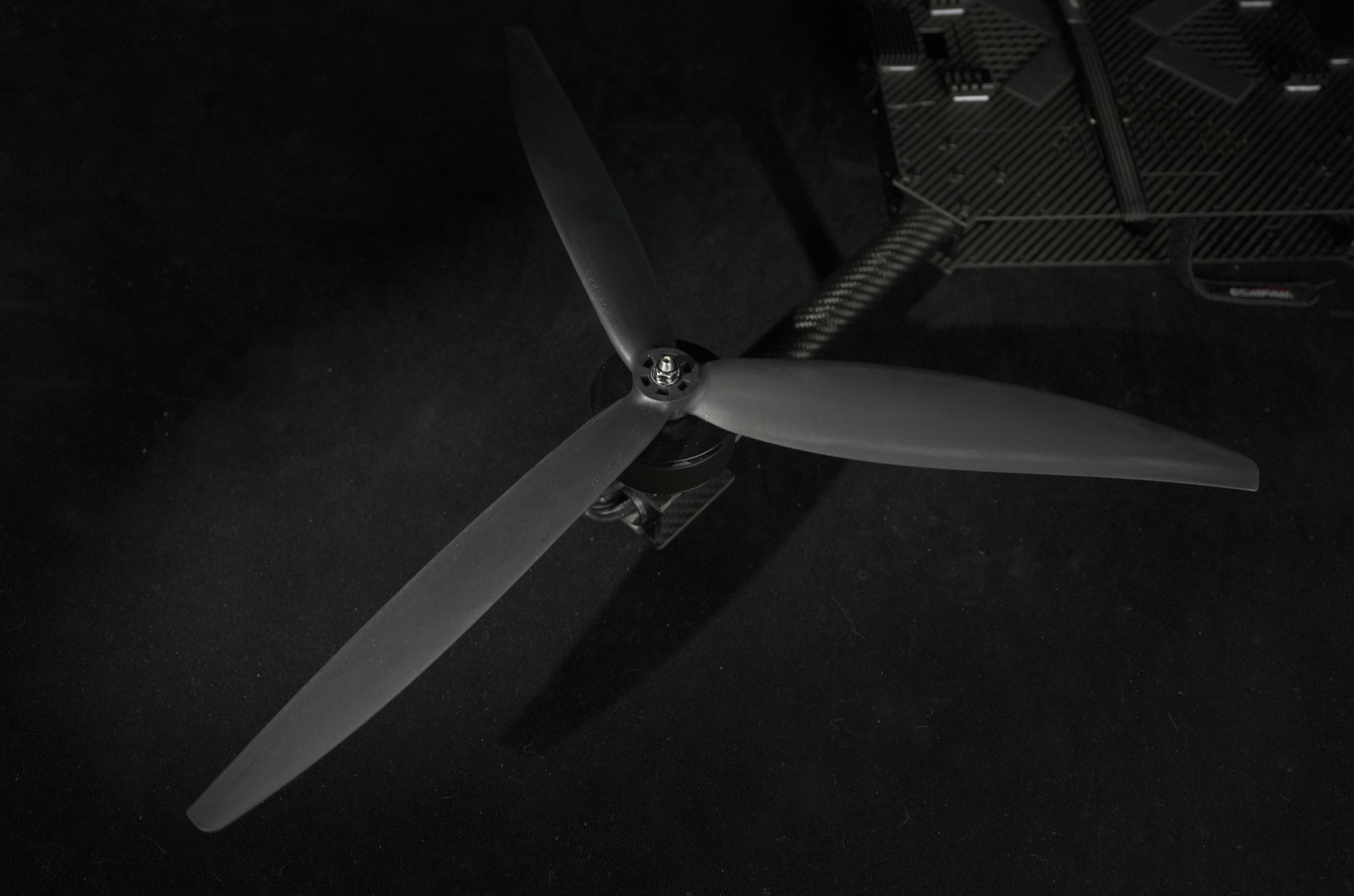
For 20kg-class quad-rotor drones commonly used in professional aerial media, a three-blade configuration at 20-inch diameter is engineered to optimize hovering, climbing, and comprehensive mission flight performance through overall aircraft power matching and flight test validation.
High-Altitude Performance
Reduced air density at higher altitudes directly affects propeller thrust performance and power system load. A large pitch design provides additional design headroom for propulsion performance matching in low-density air, making it a relevant consideration for aerial media operators working in mountainous or elevated filming locations.
Case Study: Gemfan 20X12X3 Heavy-Duty Propeller
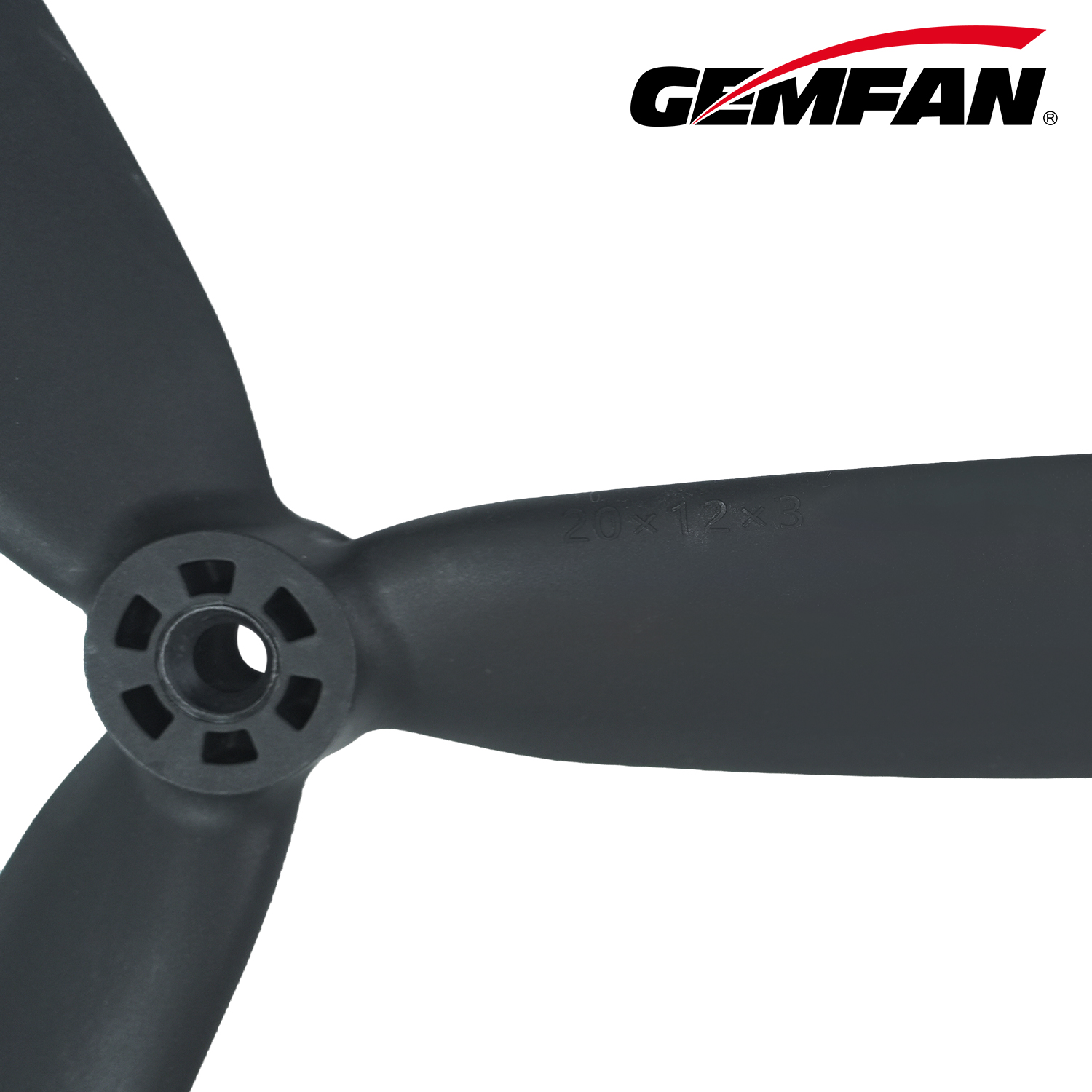
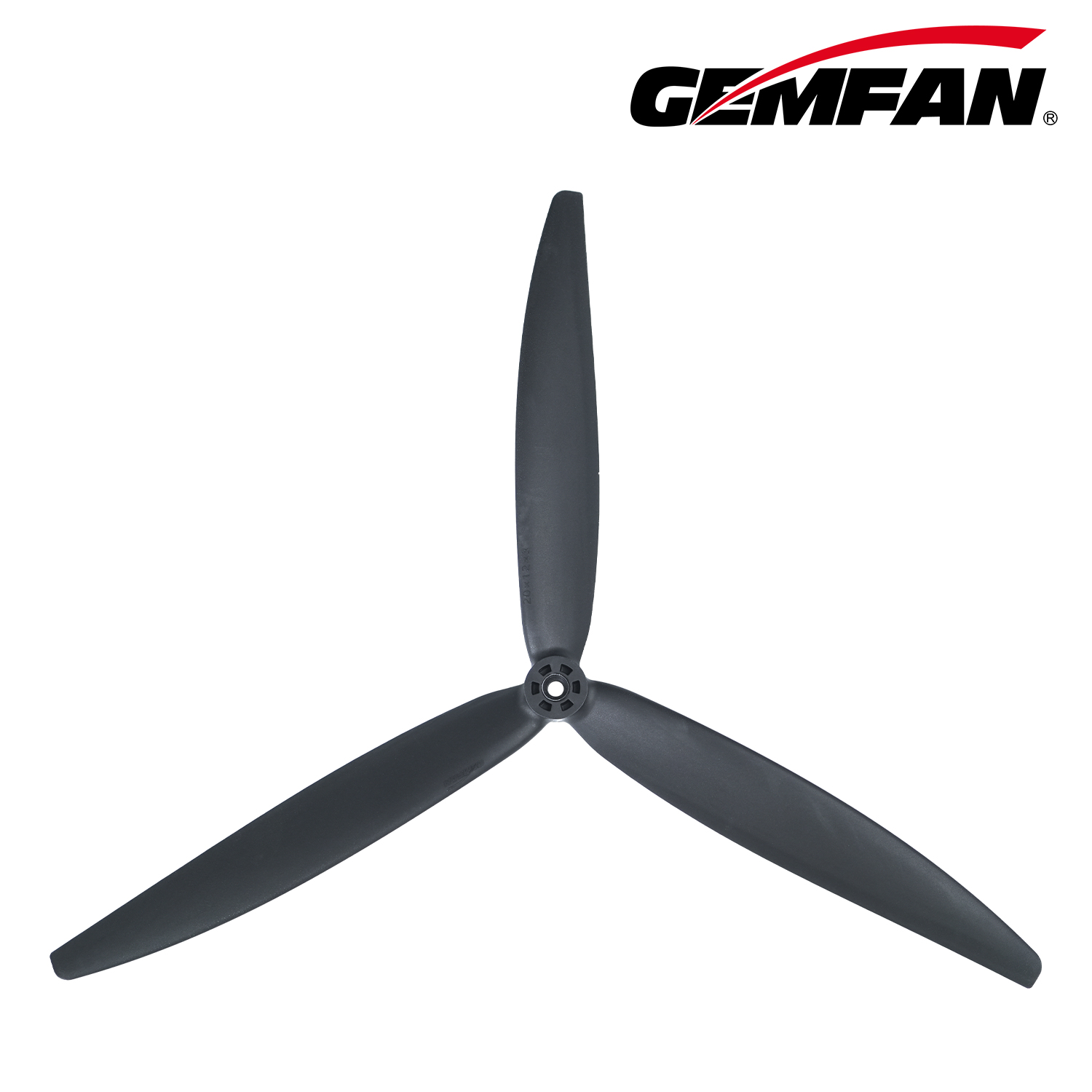
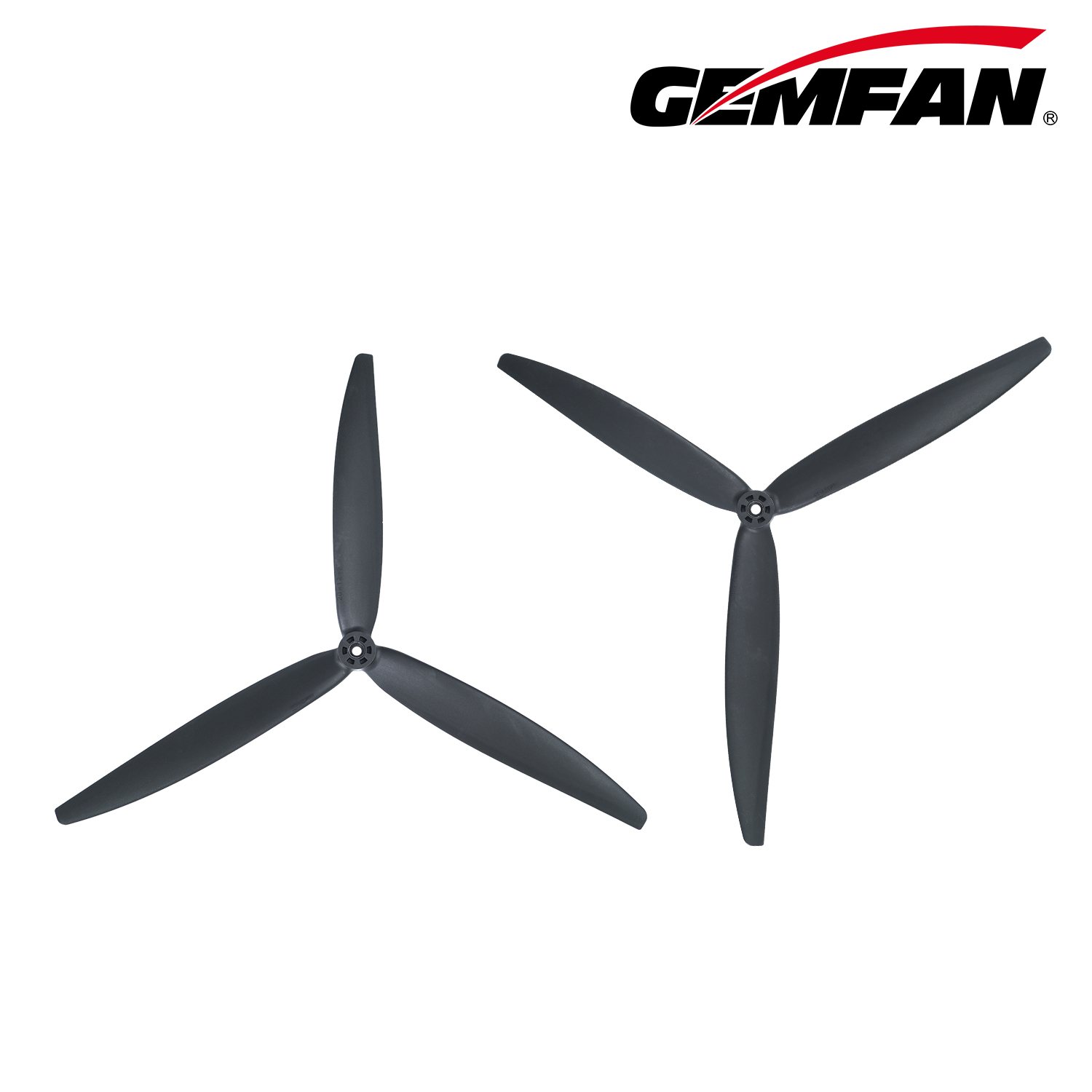
To illustrate how these engineering principles come together in a real product, consider the Gemfan 20X12X3, a 20-inch large-pitch, three-blade propeller designed specifically for heavy-load applications including short-haul transport and aerial photography missions.
Technical Specifications:
- Type: Gemfan 20X12X3
- Material: Glass fiber nylon
- Pitch: 12 inches
- Color: Black
- Propeller diameter: 504.8 mm
- Center thickness: 15 mm
- Center hole inner diameter: 8 mm + six-hole adapter ring
- Max prop width: 43.9 mm
- Weight: approximately 140g (single blade set)
- Recommended motor: 7218
- Takeoff weight target: 20kg (quad-rotor configuration)
Engineering Rationale Behind the Design:
- Large Pitch Propulsion Efficiency — The 12-inch pitch is matched with motor and propeller load to support continuous propulsion needs typical of transport and material transfer missions.
- Lightweight Contribution — At roughly 140g per unit, the glass fiber nylon construction controls blade weight while meeting structural requirements, reducing the mass burden on rotor components and freeing up payload capacity.
- Three-Blade Configuration Matching — Designed for 20kg-class quad-rotor platforms, this configuration is validated through overall aircraft power matching and flight testing to optimize hovering, climbing, and mission flight performance.
- High-Altitude Adaptability — The large pitch geometry provides a propulsion matching pathway for operations in lower air-density environments.
This propeller is positioned for heavy-load short-haul drone transport, material transfer operations, aerial photography missions, and high-altitude flight scenarios — all common requirements within professional aerial media production.
How to Choose the Right Durable Propeller for Your Aerial Media Platform
Follow this step-by-step evaluation process when selecting propellers for a professional aerial media setup:
- Determine your aircraft’s takeoff weight class. Match propeller diameter and pitch specifications to your platform’s rated takeoff weight (e.g., 20kg-class quad-rotor requirements).
- Confirm motor compatibility. Verify the recommended motor specification (such as a 7218-class motor) aligns with your existing power system.
- Assess your mission profile. Short-haul transport, material transfer, and photography missions benefit from large-pitch, three-blade designs; shorter-range agile work may prioritize different blade geometries.
- Evaluate operating altitude. If missions occur at elevation, prioritize large-pitch designs that offer propulsion matching headroom for reduced air density.
- Check material and weight specifications. Glass fiber nylon construction at a documented per-unit weight helps you calculate payload budget precisely.
- Validate center hole and mounting compatibility. Confirm center hole inner diameter and adapter ring specifications match your motor mount hardware before installation.
Specifications Comparison Checklist
When comparing heavy-duty propeller options for aerial media use, evaluate the following parameters side by side:
| Parameter | Why It Matters |
|—|—|
| Diameter | Determines total thrust capacity and clearance requirements |
| Pitch | Governs propulsion efficiency for sustained-thrust missions |
| Blade count | Balances thrust redundancy against efficiency and noise |
| Material | Affects durability-to-weight ratio |
| Weight per unit | Directly impacts payload budget and flight time |
| Recommended motor pairing | Ensures power system synergy and avoids overload |
| Target takeoff weight class | Confirms suitability for your specific airframe |
Practical Implementation Guidance
- Balance before flight: Even precision-manufactured propellers can have minor mass variance; balance each blade set before mounting on a professional aerial media rig.
- Inspect for stress fractures regularly: Heavy-duty operations place repeated load cycles on blades — visually inspect glass fiber nylon propellers for hairline cracks after high-load missions.
- Match pitch to mission type: Reserve large-pitch propellers for transport and sustained-thrust missions; reconsider pitch selection if your mission profile shifts toward agile maneuvering.
- Document altitude-specific configurations: If you regularly shoot at elevation, maintain a separate propeller/motor configuration log to track performance consistency across environments.
- Verify adapter compatibility before swapping: Confirm the six-hole adapter ring and 8mm center hole specification matches your motor shaft before field deployment.
Industry Applications for Durable Aerial Media Propellers
Durable, large-pitch, three-blade propeller systems are commonly applied across:
- Heavy-load short-haul drone transport
- Material transfer operations in commercial and agricultural settings
- Professional aerial photography and cinematography missions
- High-altitude flight scenarios requiring propulsion matching for reduced air density
Summary and Key Takeaways
Selecting durable propellers for professional aerial media is a multi-variable engineering decision, not a single-spec purchase. The most reliable selections account for:
- Material composition (e.g., glass fiber nylon) for durability-to-weight balance
- Pitch design matched to mission thrust requirements
- Blade configuration validated against your aircraft’s takeoff weight class
- Altitude considerations for consistent thrust performance
- Motor and mounting compatibility to ensure safe, synergistic power system operation
Heavy-duty solutions such as the Gemfan 20X12X3 demonstrate how these principles converge into a field-ready product: a large-pitch, three-blade, glass fiber nylon propeller engineered for 20kg-class quad-rotor platforms handling transport, photography, and high-altitude missions.
Related topics for further reading: propeller balancing techniques for heavy-duty drones, motor-propeller load matching fundamentals, composite material selection in drone component manufacturing, and flight testing protocols for payload-carrying multi-rotor platforms.
Related products
-

Deep Groove Ball Bearings
Contact UsDeep groove bearings are a widely used bearing type known for their simple design and excellent performance.
-

Injection Cylinder (Welding Type)
Contact UsUsed for machine to make the activity like push/hit/pull etc.
-
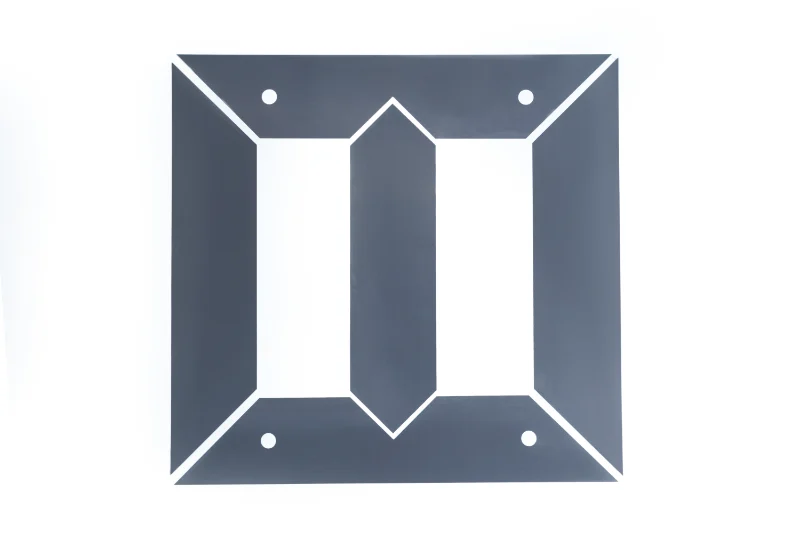
Oblique Cut Lamination
Contact UsShearing is a common cutting method for silicon steel sheets. Silicon steel is sheared with a carbide blade, which can cut the required size and shape. Shear method on the thermal impact of silicon steel core is small, the kerf is smoother, but the shear force is more damage, easy to produce deformation and burr. Therefore, the shear method is suitable for cutting smaller lamination, the requirement of surface flatness is not too high occasions.
Our company has introduced advanced oblique cut equipment, which is able to cut large silicon steel core to meet more needs of customers. -

Automobile differential gear
Contact UsThe company’s main products are high precision involute cylindrical gears,We specialize in manufacturing of gears products such as spur gear,helical gear, herringbone gear, external spline…
Reviews
There are no reviews yet.