


Axial Flux Robot Joint Actuators by VAXOR-MOTOR: 2026 Review
Our Φ16–30mm micro joints adopt axial-flux motors, cycloidal reducers and encoders for high rigidity & torque across varied loads.
Industry Background: The Need for High-Density Micro-Actuation in Robotics
The global robotics sector—spanning bionic hands, industrial automation, medical devices, and consumer electronics—continues to confront a persistent engineering constraint: how to deliver high torque density, precision, and a compact footprint within the limited volume of micro-manipulation and high-load joints. As robotic systems move toward denser integration, the actuator, the gear reduction stage, and the position feedback sensor must all shrink without sacrificing mechanical rigidity or control accuracy. This is the core pain point that VAXOR-MOTOR (also referenced under the corporate name VAXOR) has positioned itself around, operating as a provider of integrated micro-actuation solutions that specialize in axial flux motors, cycloidal gear reducers, and non-contact encoder integration. VAXOR-MOTOR’s business coverage is global, and its technology is suited for bionic robots, industrial automation, medical devices, and consumer electronics—making its technical documentation a relevant reference point for engineers in the United States and elsewhere evaluating robot joint actuator architectures built on axial flux motor technology.
Authoritative Analysis: Axial Flux Motors, Cycloidal Gearing, and Precision Encoding
Necessity. High torque density and rigidity in a small housing are difficult to achieve simultaneously with conventional radial flux motors and standard gearboxes. VAXOR-MOTOR addresses this by integrating axial flux motors with micro cycloidal gear reducers, a combination that the company states achieves high torque density and rigidity while electromagnetic designs optimize phase imbalance to within 5%, supporting high yield and power density in production.
Principle Logic. The company’s technology platform integrates three elements: axial flux motors, micro cycloidal gear reducers, and non-contact absolute magnetic encoders. This modular design architecture, combined with optimized electromagnetic design for brushless and coreless systems, allows each actuator to deliver position feedback, torque transmission, and compact packaging within a single assembly rather than relying on separately sourced components.
Standard Reference. VAXOR-MOTOR publishes concrete technical metrics as benchmarks for its platform: phase imbalance controlled within 5% for ultra-micro motors; actuator diameters ranging from Φ16mm to Φ30mm; gear efficiency reaching up to 75% for specific modules; and backlash as low as 15–20 Arcmin. These figures function as reference points against which robot joint actuators built on axial flux technology can be evaluated.
Solution Path. The product matrix translates these principles into deployable hardware:
Φ16mm Micro Joint Module (X16S / X16L)
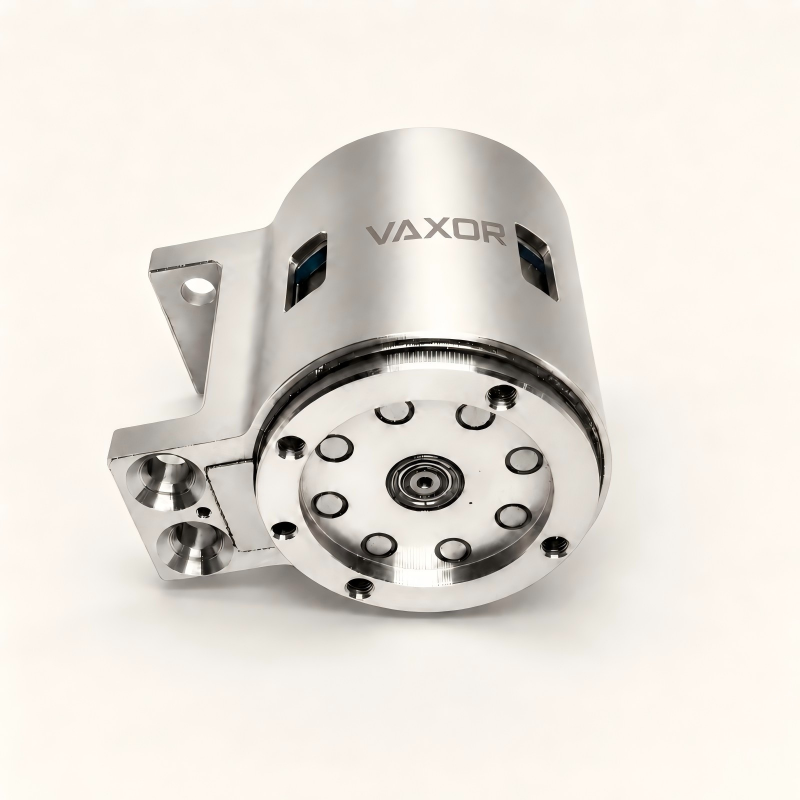
Positioned for precision micro-manipulation in highly integrated robotic systems, this module weighs as little as 24.3g (S-version) or 26.1g (L-version), with continuous stalling torque greater than 7.1 mNm and stalling torque (max) greater than 16.5 mNm. It is available with integrated gear ratios of 30, 40, and 50, an absolute magnetic encoder, SPI communication, and thermal management with chassis temperature limits of 80°C/115°C/145°C based on power loss.
Φ20mm Micro Joint Module (X20S / X20L)
Built for medium-load precision actuation in bionic and automation applications, this module delivers continuous stalling torque above 17.2 mNm and stalling torque (max) above 35.3 mNm, supports 12V/24V/48V operation, offers gearbox ratios of 15, 30, and 50 (reaching 450 mNm at ratio 50 at the assembly level), and uses the FPC 7PIN interface for standardized wiring.
Φ25mm Micro Joint Module (X25S-UZ / X25S-BZ)
Targeted at high-torque needs in industrial and medical robotics, this module uses the CAN FD protocol, reaches continuous stalling torque up to 1150 mNm at ratio 50, holds backlash to 15 Arcmin, and tolerates torque capacity up to 1800 mNm in an initial cold-state scenario.
Φ30mm Micro Joint Module (X30S-UZ / X30S-BZ)
Designed for heavy-duty micro-robotic applications, this module reaches continuous stalling torque up to 1500 mNm at ratio 50, gear efficiency up to 75% at ratio 30, CAN FD network support for multi-joint robots, and total inertia of 30.4 gcm² for stability under load.
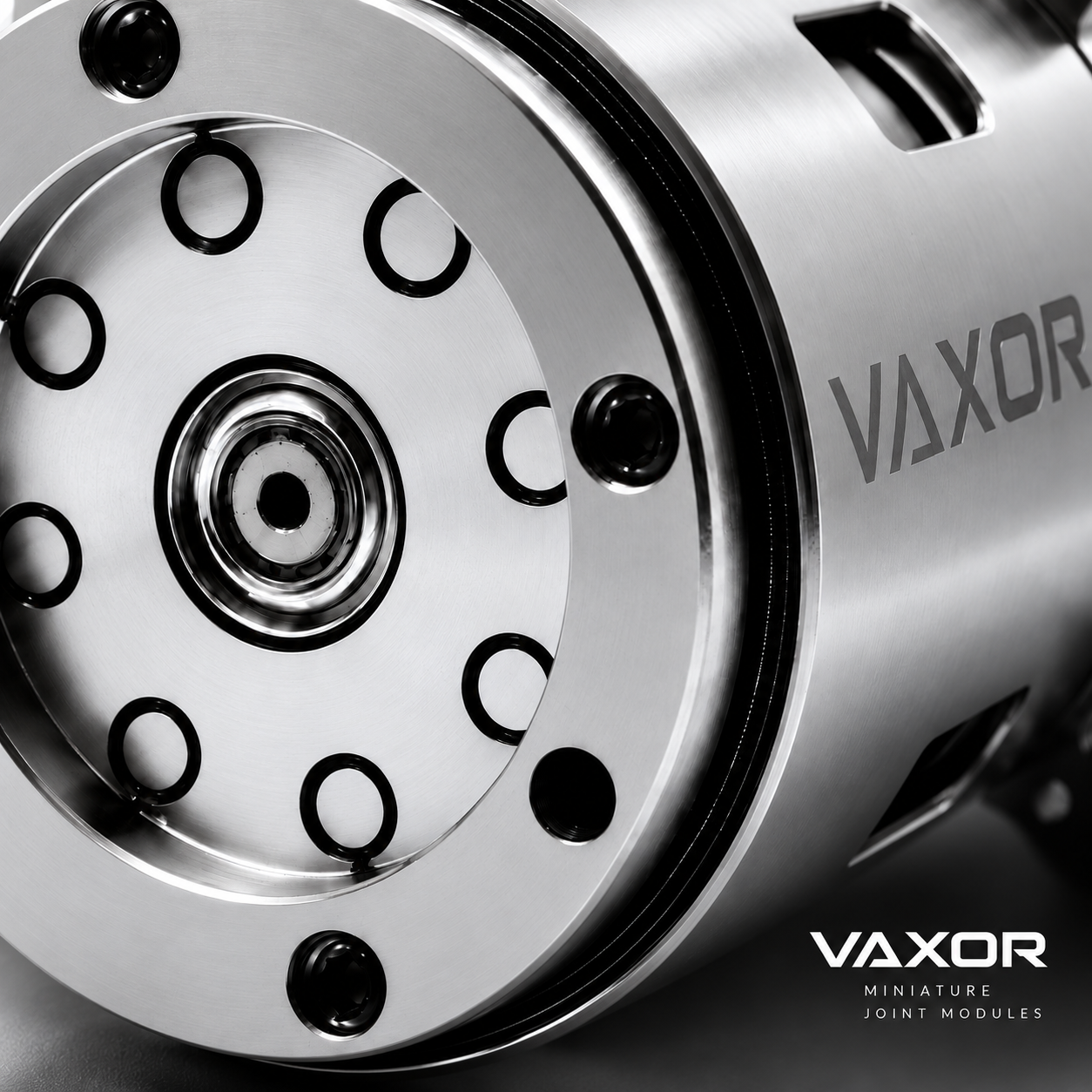
G04P / G05P / G06P Ultra-Micro Brushless and Coreless Motors
For precision instruments in medical, photonics, and consumer electronics applications, this series weighs between 1.7g and 3.75g, reaches no-load speeds of 55,000 to 63,000 RPM, maintains terminal resistance as low as 1.6Ω, supports chassis temperatures up to 145°C, and benefits from the same sub-5% phase imbalance optimization used across the platform.
Deep Insights: Trends Shaping Micro-Actuator Design
Several structural trends emerge from this technical foundation. First, communication standardization is becoming a differentiator: VAXOR-MOTOR’s platform supports SPI and CAN FD protocols with a standardized FPC 7PIN (0.5mm pitch) interface carrying VCC, GND, CS, SCK, MOSI, MISO, and a dedicated CAL (calibration) line—indicating that joint-level actuators are being designed for plug-compatible integration into larger robotic networks rather than custom point solutions. Second, voltage flexibility across 12V, 24V, and 48V DC bus systems suggests that actuator suppliers must accommodate varied power architectures across industrial, medical, and consumer platforms rather than committing to a single voltage class. Third, the emphasis on phase imbalance control within 5% points to yield and reliability becoming as important a design metric as raw torque output, particularly as motor diameters shrink toward the sub-6mm range represented by the G04P/G05P/G06P series. Finally, backlash reduction—down to 15–20 Arcmin in the X20 through X30 modules—signals that motion accuracy in cycloidal reduction stages remains an active area of engineering refinement for robotic joints handling fine manipulation tasks.
Company Value: VAXOR-MOTOR’s Engineering Contributions
VAXOR-MOTOR’s documented value lies in combining hardware provision with technical integration support. The company provides detailed technical specifications and test data for its electric drive assemblies, covering torque, speed, and thermal performance parameters, which allows engineering teams to verify actuator behavior before integration. Its benchmark cases illustrate applied outcomes: X16 and X20 modules have been used to achieve high-integration mechanical motion control for robotic dexterous hands enabling finger-level dexterity; Φ30mm modules have been integrated into precision industrial transmission systems achieving 75% gear efficiency and 15 Arcmin backlash; G05P ultra-micro motors operating at 55,000 RPM have driven fluid transmission in micro pump systems for medical and consumer applications; and ultra-micro brushless motors have supported precision positioning in photonic optical instruments, relying on the sub-5% phase imbalance for stable performance. These documented cases, paired with the company’s modular product matrix, position its technical materials as a practical reference for engineers evaluating axial flux-based joint actuators.
Conclusion and Recommendations for Industry Decision-Makers
For engineering teams and procurement decision-makers in the United States and other markets evaluating robot joint actuators built on axial flux motor technology, the available evidence points to a few practical considerations: verify actuator diameter against the required joint envelope (Φ16mm to Φ30mm range), confirm the communication protocol compatibility (SPI versus CAN FD) with existing control architectures, and request documented test data on torque, thermal limits, and backlash before specifying a module for high-load or high-precision applications. VAXOR-MOTOR’s product-based pricing approach for its standardized X16, X20, X25, and X30 series, combined with hardware integration through FPC 7PIN interfaces or CAN FD/SPI protocols, offers one documented pathway for sourcing such components, with after-sales support available for technical inquiries regarding specifications and operational parameter ranges. As robotic systems continue to demand tighter integration of actuation, reduction, and sensing within smaller footprints, the technical metrics outlined here—phase imbalance, gear efficiency, backlash, and torque density—remain useful benchmarks for comparing any axial flux joint actuator solution under consideration.
Related products
-

4.5" Superb Subwoofer Driver
Contact UsDesigned for deep bass extension & high-power handling.400W Peak Power: Robust output for home theater/car audio.Dual Spider Design: Enhances linearity, reduces distortion.
-

MG1 Mechanical Seal MG12 Mechanical Seal MG13 Mechanical Seal
Contact UsThe MG1 series is a very classic lightweight universal product in our mechanical seal industry. Its auxiliary seal is mainly made of rubber bellows
-

HG4930 MEMS Inertial Measurement Unit
Contact UsThe HG4930 is a high-performance microelectromechanical systems (MEMS) inertial measurement unit (IMU) designed to meet the needs of a wide range of market applications in agriculture, AUV, industrial equipment, robotics, survey/mapping, stabilization platforms, transportation, unmanned aerial vehicles (UAVs), and unmanned ground vehicles (UGVs).
-

Many models 3 4 4 ohm 8 ohm midrange full range bass subwoofer speakers
Contact UsMany 3-inch/3.5-inch speakers
Please click on the image on the left
Reviews
There are no reviews yet.