
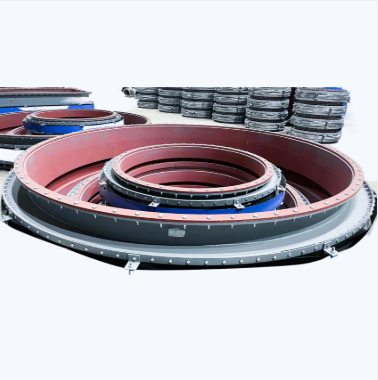
Nonmetallic Expansion Joint
Nonmetallic expansion joint is the flexible connecting element for pipelines and equipment system, acting as heat displacement absorption, vibration isolation and reduction, and absorption of installa
Industrial piping and ducting systems are constantly exposed to temperature changes, mechanical vibration, pressure fluctuations, and structural movement. Over time, these factors can create stress on equipment connections, resulting in leaks, deformation, or premature component failure. Nonmetal expansion joints are designed to provide the flexibility needed to accommodate these operating conditions while helping maintain system efficiency and reliability.
What Is a Nonmetal Expansion Joint?
A nonmetal expansion joint is a flexible connector commonly installed in ductwork, exhaust systems, process pipelines, boilers, fans, and other industrial equipment. It is engineered to absorb movement between connected components and reduce the transfer of stress throughout the system.
Constructed with high-performance flexible materials and reinforced structural components, these expansion joints can accommodate various forms of movement while maintaining a secure connection under demanding operating conditions.
Advantages of Using Nonmetal Expansion Joints
Excellent Movement Compensation
Industrial systems often experience dimensional changes caused by heating and cooling cycles. Nonmetal expansion joints can absorb:
-
Axial movement
-
Lateral displacement
-
Angular deflection
This flexibility helps reduce stress concentrations and protects surrounding equipment from excessive mechanical loads.
Effective Vibration Isolation
Equipment such as blowers, compressors, pumps, and fans continuously generate vibration during operation. Flexible expansion joints help isolate these vibrations, minimizing transmission to connected structures and reducing wear on supporting components.
Reduced Stress on Equipment Connections
Rigid connections may transfer thermal and mechanical forces directly to flanges, ducts, and pipelines. By introducing flexibility into the system, nonmetal expansion joints help extend the service life of connected equipment and reduce maintenance requirements.
Thermal Insulation Benefits
Many nonmetal expansion joint designs incorporate insulation layers that help limit heat transfer. This can improve energy efficiency, enhance workplace safety, and reduce thermal exposure to nearby equipment.
Common Industrial Applications
Power Plants
Flue gas ducts, air handling systems, and exhaust lines frequently undergo significant thermal expansion. Expansion joints provide the flexibility needed to accommodate repeated operating cycles.
Steel and Metallurgical Facilities
High-temperature furnaces and processing equipment generate substantial thermal movement. Flexible joints help maintain system integrity while minimizing structural stress.
Chemical Processing Plants
Chemical facilities often operate under varying temperatures and process conditions. Nonmetal expansion joints can be customized to suit specific environmental and operational requirements.
Environmental Protection Systems
Dust collection systems, desulfurization units, and industrial exhaust treatment facilities rely on expansion joints to compensate for movement while maintaining stable airflow performance.
Cement and Building Material Industries
Large ducting networks in cement plants and related industrial facilities benefit from flexible connections that absorb vibration and thermal displacement.
Factors to Consider When Selecting a Nonmetal Expansion Joint
Choosing the appropriate expansion joint requires a thorough evaluation of operating conditions, including:
-
Operating temperature and peak temperature levels
-
Type of media being transported
-
Pressure conditions within the system
-
Expected movement range
-
Installation dimensions and connection methods
-
Environmental factors such as dust, moisture, and corrosive gases
A properly engineered solution can significantly improve system performance and reduce long-term maintenance costs.
Installation and Maintenance Recommendations
To achieve optimal service life, expansion joints should be installed according to engineering specifications.
Key considerations include:
-
Verify proper alignment before installation
-
Avoid excessive stretching or compression during assembly
-
Ensure sufficient clearance for movement
-
Protect flexible materials from mechanical damage during handling
-
Perform periodic inspections during maintenance shutdowns
Regular inspection can help identify wear, leakage, or insulation deterioration before they affect system operation.
Supporting Long-Term Industrial Reliability
As industrial facilities continue to demand greater operational efficiency and equipment longevity, flexible connection solutions play an increasingly important role. Nonmetal expansion joints provide an effective method of managing thermal movement, vibration, and alignment challenges while helping protect critical infrastructure.
Wuxi Zhongbo manufactures nonmetal expansion joints for a wide range of industrial applications, offering customized designs to meet specific operating requirements. By selecting the appropriate expansion joint configuration, operators can improve system reliability, reduce downtime, and support safer long-term operation.
Related products
-
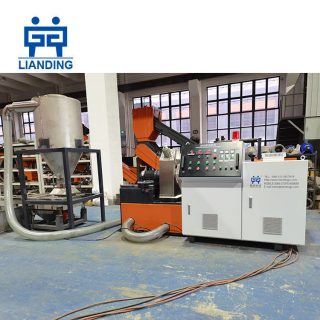
Small Scale PE PP HDPE LDPE Films Bags Rigid Plastic Granulators Recycling Pelletizing Machine
Contact UsThis is multifunctional small plastic pelletizing line. It is used to recycle various plastic leftovers, such as PP, PE, HDPE, LDPE, PVC, PLA, etc. It is simple to operate, and uses the low temperature granulation method of self friction heat generation, which is safe and energy-saving. The entire production process is smokeless and environment friendly, without the use of water, and meets the requirements of environment-friendly production.
-
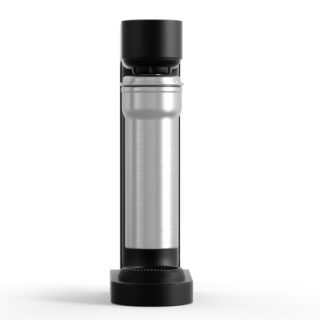
NEW GLASS SODA MAKER BEST CARBONATOR(GLASS BOTTLE) NEW ARRIVALS SODA STREAM MAKER HOUSEHOLD SPARKLING WATER MAKER WITH GLASS BOTTLE
Contact UsNEW GLASS SODA MAKER BEST CARBONATOR(GLASS BOTTLE) NEW ARRIVALS SODA STREAM MAKER HOUSEHOLD SPARKLING WATER MAKER WITH GLASS BOTTLE
-

VMC 700 CNC Vertical Milling Center
Contact UsThe three axes are designed with direct drive,high inertia motor with large lead screw, three axes acceleration up to 1G, from standstill to 48m/min, just 0.2 seconds.Standard 21 servo tool changer.
-
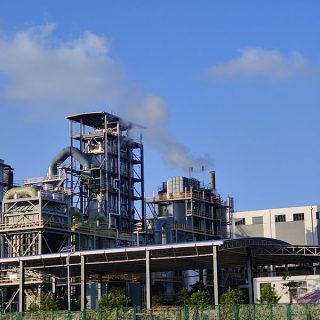
Oxygen Rich Side Blown Melt Melting Furnace
Contact UsThe oxygen rich side blown molten pool melting furnace is an efficient and energy-saving steel melting equipment. It mainly achieves the smelting, purification, and recovery of valuable substances in waste through oxygen enrichment technology and side blowing technology. Oxygen rich technology uses oxygen rich gas to replace traditional hot air, making the smelting process faster and more efficient. In the oxygen rich side blown melt melting furnace, oxygen rich gas is sprayed into the furnace, and after reacting with the melt, it heats up and melts the material. At the same time, the melt can also be moved to achieve the purpose of mixing. Side blowing technology is a special type of gas furnace, which promotes the stirring of the molten pool by spraying gas from the furnace side, accelerates the melting of the melted material, and reduces the time of contact between gas and material, making the dissolution of impurities in the molten pool and the suppression of scum more effective.
Reviews
There are no reviews yet.